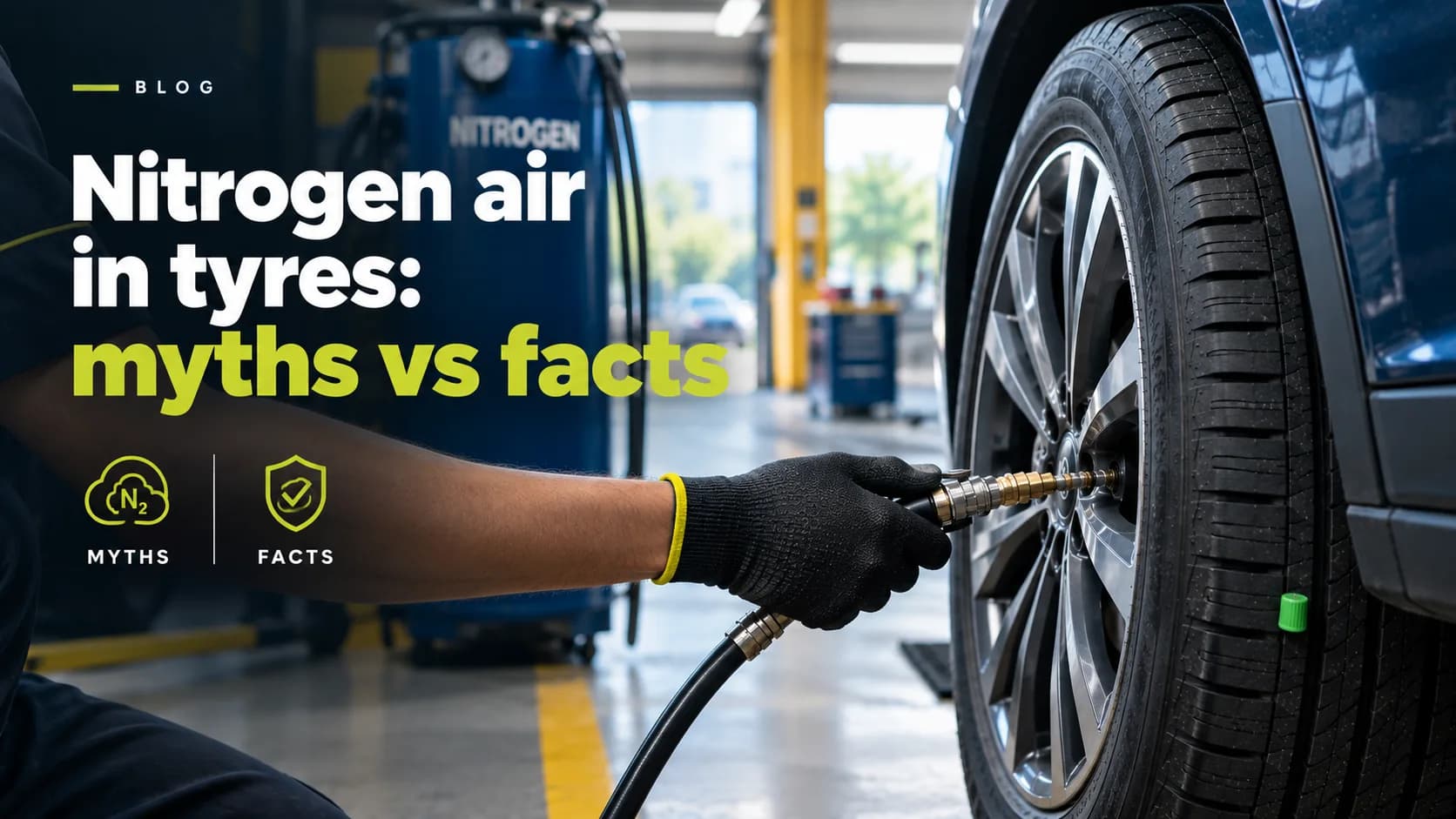
Short answer: nitrogen is a genuine but modest improvement over ordinary air. A tyre filled with dry nitrogen loses pressure a little more slowly and keeps moisture out of the wheel. It does not cool your tyres, it will not noticeably improve your mileage on its own, and it does not mean you can stop checking your pressures. The right pressure matters far more than which gas is inside.
Nitrogen filling is one of the questions we hear most across our counters — and one of the most over-sold services in the tyre trade. Here is what is true, what is not, and when it is worth having.
First, the fact that surprises most people
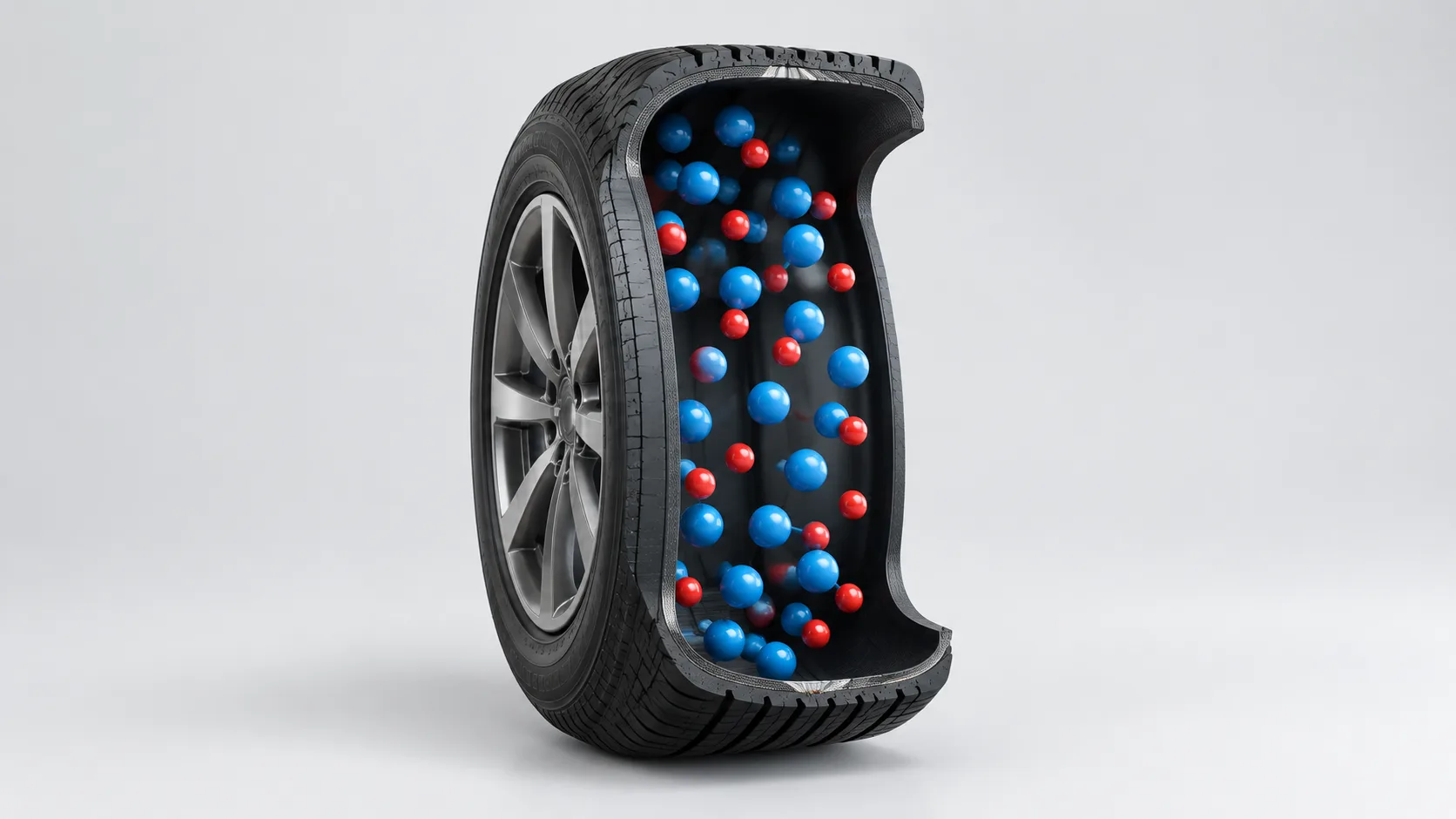
The air we breathe is already about 78% nitrogen. Oxygen makes up about 21%, and the last 1% is mostly argon, with a little carbon dioxide and water vapour. So nitrogen filling does not replace air with something exotic. It raises the nitrogen from about 78% to well over 90%, and takes out most of the oxygen and the moisture.
That small change is where every real benefit of nitrogen comes from. Keep it in mind as you read the myths below.
Myth vs fact at a glance
| Myth | Fact |
|---|---|
| With nitrogen, you never need to check pressure | Nitrogen leaks too, just more slowly. Check at least monthly. |
| Nitrogen keeps tyres cool | The right pressure keeps tyres cool. Nitrogen has no cooling property of its own. |
| Nitrogen does not expand in the heat | Dry nitrogen and dry air expand almost identically. Moisture in ordinary air is what makes pressure swing more. |
| Nitrogen gives much better mileage | The right pressure saves fuel. Nitrogen only helps by holding it a little longer. |
| You cannot top up nitrogen tyres with air | You can, safely. It only dilutes the nitrogen. |
| Aircraft and F1 cars use it, so every car needs it | They use it for conditions a road car never sees. |
| Nitrogen makes tyres last much longer | Pressure, alignment and rotation decide tyre life. Nitrogen’s part is small. |
Myth 1: “With nitrogen, I never need to check my tyre pressure”
Every tyre loses pressure over time, whatever is inside it. Gas slowly works its way through the rubber, and the valve, the bead where the tyre seals against the rim, and any small puncture all leak regardless.
What nitrogen changes is the speed. Oxygen passes through tyre rubber faster than nitrogen does, so a nitrogen-filled tyre loses pressure more slowly. In a year-long test by the US magazine Consumer Reports, tyres filled with nitrogen lost an average of 2.2 psi, against 3.5 psi for tyres filled with air.
That is a real difference — but it is about 1 psi over a whole year. A tread puncture, a perished valve or a knock against a kerb can take far more than that in a week. Keep checking at least once a month, nitrogen or not.
Myth 2: “Nitrogen keeps tyres cool”
A tyre heats up because its rubber flexes as it rolls, and an under-inflated tyre flexes more and runs hotter. Nitrogen has no special cooling property — it absorbs and gives off heat almost exactly like air does.
Its only link to temperature is indirect: by holding the right pressure a little longer, it keeps the tyre out of the soft, over-flexing zone for longer. In Gujarat summer heat, on a long highway run, that zone is genuinely dangerous — which is why the pressure, not the gas, is what protects the tyre.
Myth 3: “Nitrogen does not expand when it gets hot”
Every gas expands when it is heated, and nitrogen behaves almost exactly like dry air. Tyre pressure rises by roughly 1 psi for every 5°C either way.
The difference people do notice is moisture. Air from an ordinary workshop compressor carries water vapour, and water vapour makes pressure swing more as a tyre heats up and cools down. Nitrogen from a generator is dry, so the pressure moves more predictably. That steadiness is real — but it comes from taking the water out, not from anything special about nitrogen.
On a 45°C Ahmedabad afternoon, your tyres will read higher than they did in the morning, whatever is inside them. That is why pressures should always be set cold — see what tyre pressure should I run?
Myth 4: “Nitrogen gives a big jump in mileage”
Under-inflated tyres waste fuel, because a soft tyre takes more effort to roll. Keeping tyres at the right pressure is what saves fuel.
Nitrogen can help a little by keeping the pressure right for longer between checks. But if you already check your tyres every month, the fuel difference is too small to notice. Anyone promising a big mileage gain from nitrogen alone is overselling it.
Myth 5: “Once it has nitrogen, you can never add normal air”
You can top up a nitrogen-filled tyre with ordinary air at any time. It is completely safe — mixing only dilutes the nitrogen, so you lose some of its slow-leak benefit.
Driving on a low tyre while you search for a nitrogen machine is far worse than topping up with air at the nearest pump. You can have it refilled with nitrogen at your next visit.
Green valve caps Many tyre shops fit green valve caps to tyres filled with nitrogen. They are only a reminder of what is inside — the cap itself does nothing, and a missing cap does not let the nitrogen out. The valve does the sealing; the cap keeps dust and water off it.
Myth 6: “Aircraft and F1 cars use nitrogen, so my car must need it”
Aircraft tyres go from far below freezing at cruising altitude to intense heat under heavy braking on landing, and racing tyres run at temperatures an everyday car never reaches. At those extremes, a dry gas that behaves predictably matters, and nitrogen’s refusal to feed a fire is a real safety advantage in an overheated tyre.
A car in city traffic or on the highway never sees those conditions. That is why nitrogen is a sensible extra for a road car, not a necessity.
Myth 7: “Nitrogen makes tyres last much longer”
There is a small truth here. Oxygen inside a tyre very slowly ages the rubber from within, and moisture can corrode steel wheels and valve parts over the years, so nitrogen may help at the margins.
But tyres almost always wear out at the tread long before the inside ages. What really decides how long a tyre lasts is correct pressure, wheel alignment, regular rotation and how the car is driven. For when a tyre is actually finished, see when do I need to replace my tyres?
So, is nitrogen worth it?
It is worth having if:
- You do not check your pressures often and want them to hold steadier between checks.
- You drive long highway distances, especially in Gujarat summer heat.
- Your vehicle stands unused for long spells.
- You have alloy wheels or tyre pressure sensors and want moisture kept away from them.
It matters much less if you already check your pressures every month and drive mostly in town. Either way, the most important thing is the number on the gauge, not the gas behind it.
How we fill nitrogen at SPC
At our Ahmedabad branches, nitrogen filling takes 10 to 15 minutes for a set of four. We purge the existing air first, fill with dry nitrogen to the pressure your vehicle manufacturer specifies — the figure on your door sticker, not the maximum moulded on the tyre — check the valve caps, and do the spare as well as all four.
If a tyre keeps losing pressure, nitrogen will not fix it: that is a leak, and it needs finding. Usually it is a repairable tread puncture, a perished valve or a damaged rim. Ask at any SPC branch, or message us on WhatsApp.
Common questions
Is nitrogen better than normal air for tyres?
Slightly. Nitrogen-filled tyres lose pressure more slowly than air-filled ones and stay free of moisture, so their pressure holds steadier. The benefit is real but modest — keeping tyres at the right pressure matters far more than which gas is used.
How often should I check nitrogen-filled tyres?
At least once a month and before any long drive — the same as tyres filled with air. Nitrogen leaks more slowly, but tyres still lose pressure through punctures, valves and the rim seal.
Can I mix nitrogen and normal air in my tyres?
Yes. Topping up a nitrogen-filled tyre with ordinary air is completely safe. It only dilutes the nitrogen and reduces its slow-leak benefit, and the tyre can be refilled with nitrogen later.
Does nitrogen improve mileage?
Not on its own. Fuel is saved by running tyres at the right pressure. Nitrogen can help indirectly by holding that pressure a little longer, but if you check your tyres monthly the difference is too small to notice.
Does nitrogen keep tyres cool in summer?
No. Nitrogen has no cooling property of its own. Tyres run cooler when they are correctly inflated, because a soft tyre flexes more and builds more heat. Nitrogen helps only by keeping the pressure right for longer.