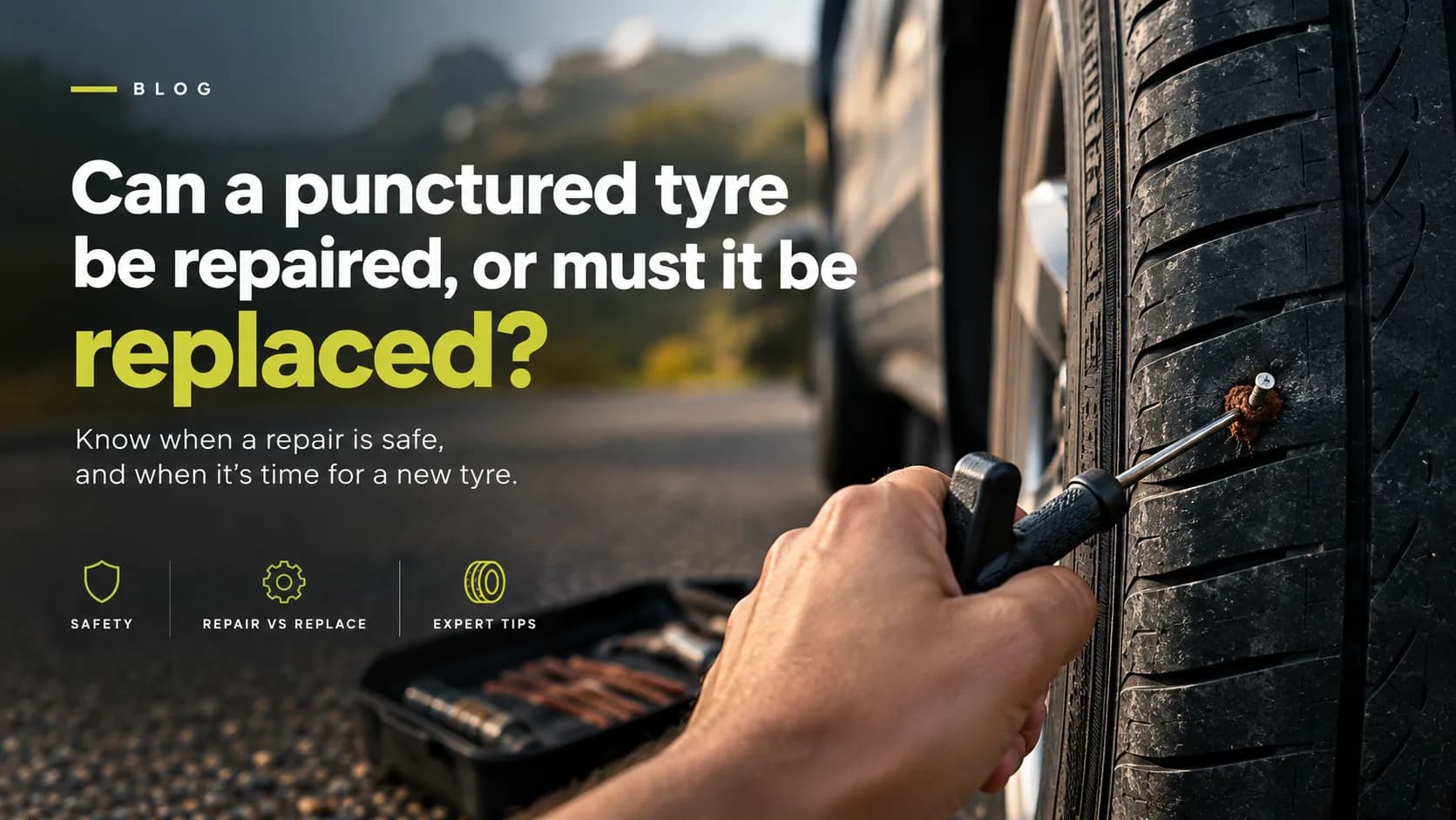
A puncture can be repaired if it is in the central three-quarters of the tread, smaller than about 6 mm, and the tyre still has legal tread and has not been driven on flat. Shah Patel & Co. repairs those with a patch-plug fitted from inside the tyre, which seals the inner liner and the puncture channel together. A tyre must be replaced instead if the damage is in the sidewall or shoulder, if it was driven on while flat, if the cords are exposed, or if there is already a repair in the same area.
The repairable area
A tyre is only repairable across the middle of the tread — roughly the central three-quarters. The shoulder and sidewall flex on every single wheel revolution, and no patch will stay bonded through that. This is not a shop being cautious; a sidewall repair fails, and it fails at speed.
| Where the damage is | Verdict |
|---|---|
| Central three-quarters of the tread, under 6 mm | Repairable |
| Shoulder — the curved edge of the tread | Not repairable |
| Sidewall | Not repairable |
| Tread, but larger than about 6 mm | Not repairable |
| Within about 40 cm of an existing repair | Not repairable |
The four automatic replacements
Regardless of where the puncture is, a tyre is finished if any of these apply:
- It has been driven on while flat, even for a short distance. The sidewall has been folded against itself and the casing is damaged internally where you cannot see it.
- The cords or steel belt are visible through the injury.
- The tread is already at or near 1.6 mm — repairing a tyre with weeks of life left is money wasted.
- The tyre is over five to six years old by its DOT code.
How a proper repair is done
A repair worth trusting is done from the inside, which means the tyre comes off the rim. There is no way to inspect the inside of a tyre with it still fitted, and inspection is the part that decides whether a repair is safe at all.
- The tyre is removed from the rim and the inside is inspected for hidden damage.
- The puncture channel is cleaned and prepared.
- A combined patch-plug is fitted from the inside: the plug fills the channel, the patch seals the inner liner.
- The tyre is refitted, inflated, and rebalanced — removing a wheel changes its balance.
Why not just a plug from the outside? An external plug fills the hole but does not seal the inner liner, and it is fitted without anyone ever looking inside the tyre for the damage that decides whether repair is safe. It is a get-you-home fix, not a repair. The same applies to aerosol sealant.
How long does a proper repair last?
A correctly fitted patch-plug in the repairable area lasts the remaining life of the tyre. It is not a temporary measure and there is no need to replace the tyre early because of it. What you should not do is accumulate repairs — several punctures in the same region of one tyre means replacement.
What to do when it happens
- Do not drive on a flat tyre. That single decision is what turns a repairable puncture into a replacement.
- If the tyre is tubeless and losing air slowly, drive gently and directly to a shop.
- If it is flat, fit the spare, or ring us.
- Leave whatever is stuck in the tread where it is — it is holding some of the air in, and it shows us exactly where to look.
Common questions
Can a puncture in the sidewall be repaired?
No. The sidewall flexes on every wheel revolution and no repair will stay bonded through that movement, so a sidewall puncture means the tyre must be replaced. The same applies to the shoulder, the curved area where the tread meets the sidewall. Only the central three-quarters of the tread is repairable.
How long does a tyre puncture repair last?
A patch-plug repair correctly fitted from inside the tyre, in the repairable area of the tread, lasts the remaining life of the tyre. It is a permanent repair, not a temporary one. Shah Patel & Co. repairs punctures in about 20 to 30 minutes and rebalances the wheel afterwards.
Is it safe to drive on a punctured tyre?
No, and driving on a flat tyre is what most often turns a repairable puncture into a replacement — the sidewall folds against itself and the casing is damaged internally where it cannot be inspected. If a tubeless tyre is losing air slowly, drive gently straight to a shop. If it is flat, fit the spare.