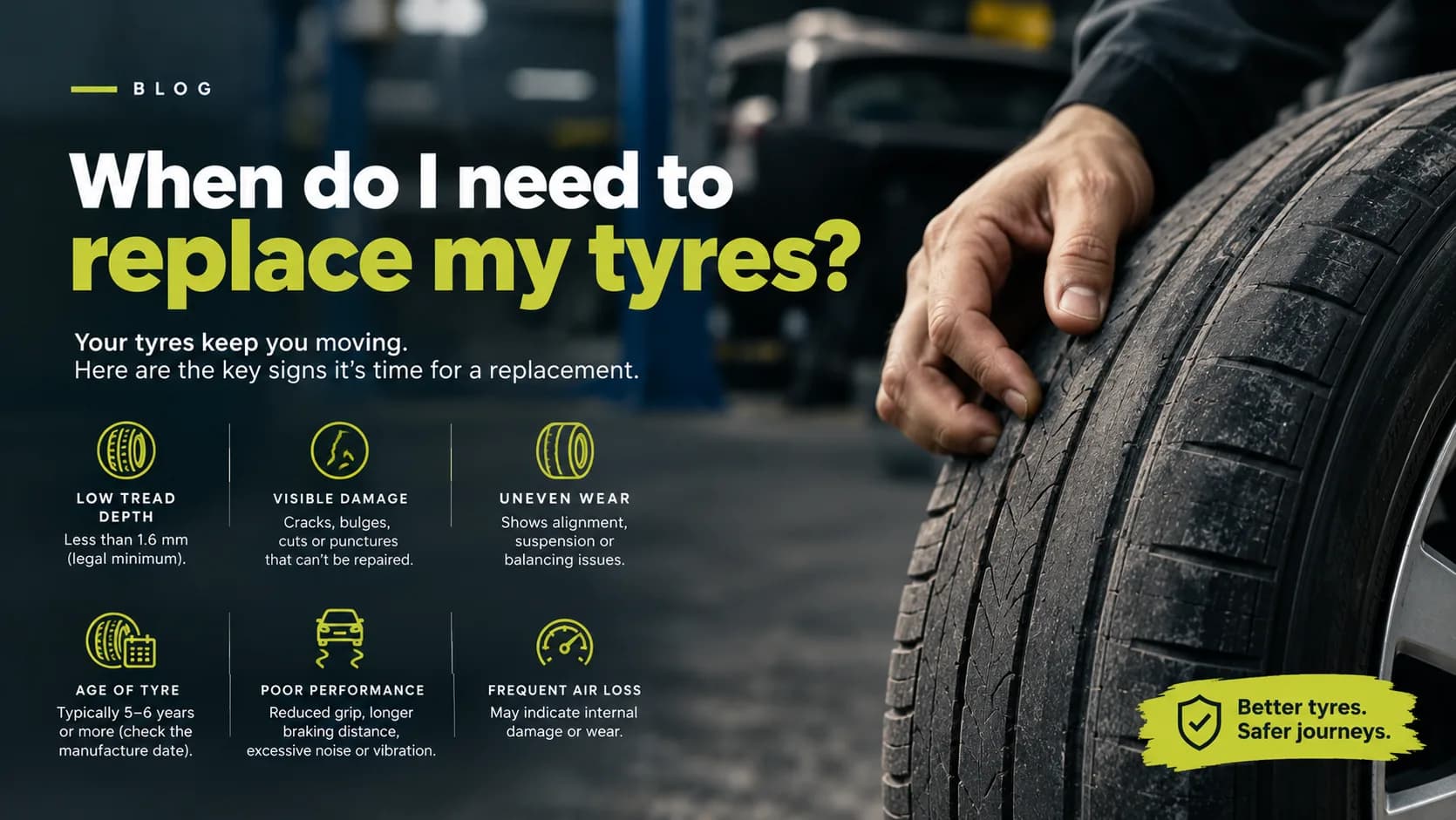
A tyre must be replaced once its tread reaches 1.6 mm, which is the legal minimum in India and the depth the tread wear indicator bars are moulded to. In practice Shah Patel & Co. advises replacing at around 3 mm, because wet braking distance lengthens sharply below that. Depth is not the only trigger: replace a tyre regardless of tread if it is more than five to six years old, if the sidewall is cracked, bulging or cut, or if the wear is uneven across the tread — that last one usually means an alignment problem that will destroy the new tyre too.
The four checks, in order
Tread depth is the check everyone knows about, and it is the one that matters least often. Most tyres that need replacing in Ahmedabad are replaced for age, damage or uneven wear — not because they wore evenly down to the limit.
1. Tread depth
Every tyre has tread wear indicators: small raised bars sitting at the bottom of the main grooves, moulded to exactly 1.6 mm. When the surrounding tread wears flush with those bars, the tyre is at the legal limit and must come off.
The honest advice is to replace earlier than that. Between 3 mm and 1.6 mm a tyre loses wet grip disproportionately fast, because there is no longer enough groove volume to move water out from under the contact patch. If you drive in monsoon conditions, 3 mm is the number to work to.
| Tread depth | What it means |
|---|---|
| 6–8 mm | New or nearly new. Nothing to do. |
| 4–5 mm | Half worn. Fine, but start planning. |
| 3 mm | Replace now if you drive in the monsoon. |
| 1.6 mm | Legal limit. The tyre is illegal below this. |
| Below 1.6 mm | Unroadworthy. Replace before driving further. |
2. Age
Rubber hardens whether or not the car is driven, and a hard tyre grips less. Every tyre carries a four-digit DOT code on the sidewall: the first two digits are the week, the last two the year. “2223” means the twenty-second week of 2023.
Replace at five to six years from that date regardless of tread depth, and be especially careful with a low-mileage car — a five-year-old tyre with 6 mm of tread left is still a five-year-old tyre. This catches a lot of people out on a second car or a weekend vehicle.
3. Damage
Any of these means the tyre comes off, whatever the tread looks like:
- A bulge or blister in the sidewall — the casing cords inside have failed and the tyre can let go without warning.
- A cut deep enough to show the fabric or steel underneath.
- Cracking along the sidewall or in the base of the grooves, which is age and heat damage.
- A tyre that has been driven on while flat, even briefly — the sidewall has been folded and creased against itself.
4. Uneven wear — the one that costs you twice
If one edge of the tread is worn and the other is not, or the centre is worn and the shoulders are not, the tyre is telling you something about the car rather than about itself. Fitting a new tyre without fixing the cause simply wears the new one out the same way.
| Wear pattern | Usual cause |
|---|---|
| One edge only | Camber or toe out of specification — needs alignment |
| Both edges, centre fine | Chronically under-inflated |
| Centre only | Chronically over-inflated |
| Patchy or cupped | Out of balance, or worn shock absorbers |
| Feathered across the blocks | Toe out of specification |
Bring the car in rather than guessing Any SPC branch will measure tread depth at each wheel position and read the wear pattern with you, at no charge. If the pattern points at alignment or a worn shock, you will be told that before you are sold a tyre — replacing a tyre without fixing the cause is money spent twice.
Do I have to replace all four?
Not necessarily, but never replace just one on its own axle. Tyres should be replaced in pairs across an axle so that both sides have the same grip and the same rolling circumference. If you are only buying two, they go on the REAR axle, even on a front-wheel-drive car — the fresher tyres belong where a loss of grip is hardest to catch, and a rear-end slide is far more difficult to correct than understeer at the front.
Common questions
What is the legal minimum tread depth in India?
1.6 mm across the central three-quarters of the tread. Every tyre has tread wear indicator bars moulded to exactly that depth, so when the tread is flush with the bars the tyre is at the legal limit. Shah Patel & Co. advises replacing at around 3 mm instead, because wet braking distances lengthen sharply below that.
How old is too old for a tyre?
Five to six years from the date of manufacture, regardless of how much tread is left. The four-digit DOT code on the sidewall gives the week and year — “2223” is week 22 of 2023. Rubber hardens with age whether the car is driven or not, so a low-mileage car can easily need tyres on age alone.
Can I replace just one tyre?
You can, but it should be paired with a new tyre on the other side of the same axle so both wheels have matching grip and rolling circumference. If you are buying two tyres, fit them to the rear axle even on a front-wheel-drive car, because a rear-end slide is much harder to correct than front-end understeer.