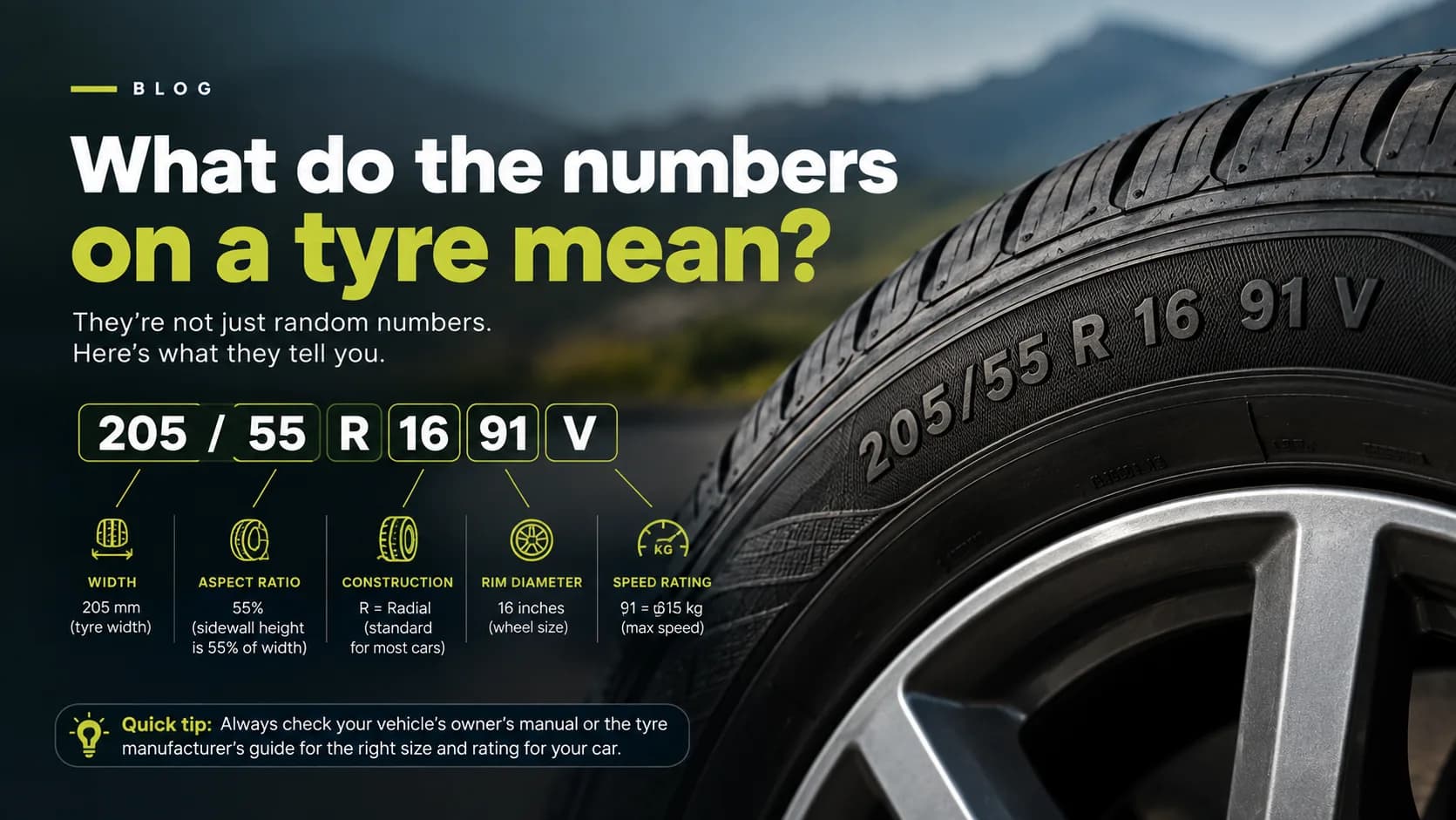
On a marking like 205/55 R16 91V, 205 is the tyre’s width in millimetres, 55 is the sidewall height as a percentage of that width, R means radial construction, 16 is the wheel rim diameter in inches, 91 is the load index (615 kg per tyre) and V is the speed rating (240 km/h). The width, aspect ratio and rim diameter must match what the vehicle manufacturer specified. The load index and speed rating may be higher than specified but must never be lower.
Reading it left to right
| Marking | Name | What it means |
|---|---|---|
| 205 | Section width | Tyre width in millimetres, sidewall to sidewall. |
| 55 | Aspect ratio | Sidewall height as a percentage of the width. 55% of 205 mm ≈ 113 mm. |
| R | Construction | Radial. Almost every modern car tyre is radial. |
| 16 | Rim diameter | The wheel it fits, in inches. Must match exactly. |
| 91 | Load index | Maximum load per tyre. 91 = 615 kg. |
| V | Speed rating | Maximum sustained speed. V = 240 km/h. |
Which of these can I change?
This is the question worth getting right, because the answer is not the same for every number on the sidewall.
- Rim diameter — fixed. A 16-inch tyre fits a 16-inch wheel and nothing else.
- Width and aspect ratio — change these only as a deliberate, matched pair that keeps the overall rolling diameter within about 3% of standard. Get it wrong and the speedometer reads wrong, the ABS and traction control calculate wrong, and on some cars the tyre fouls the arch on full lock.
- Load index — may be higher than specified, never lower. Lower is a genuine safety issue, not a technicality.
- Speed rating — may be higher, never lower. Note that a higher rating usually means a stiffer sidewall and a firmer ride.
Where to find what your car actually needs The specified size is on a sticker in the driver’s door shut, in the fuel filler flap or in the handbook — not necessarily on the tyres currently fitted, which may be wrong. If you cannot find it, tell any SPC branch your make, model and year and we will look it up.
The load index table
Load index is a code, not a weight. These are the values that come up most often on Indian cars and SUVs:
| Load index | Max load per tyre |
|---|---|
| 79 | 437 kg |
| 82 | 475 kg |
| 85 | 515 kg |
| 88 | 560 kg |
| 91 | 615 kg |
| 94 | 670 kg |
| 98 | 750 kg |
| 104 | 900 kg |
The speed rating letters
| Letter | Max speed |
|---|---|
| T | 190 km/h |
| H | 210 km/h |
| V | 240 km/h |
| W | 270 km/h |
| Y | 300 km/h |
The other markings that matter
- DOT code — four digits giving week and year of manufacture. “2223” is week 22 of 2023. This is how you tell a tyre’s real age.
- Tubeless / Tube Type — printed on the sidewall. A tube-type tyre must not be run without a tube.
- An arrow or “Outside” marking — a directional or asymmetric tyre only works fitted the right way round.
- Tread wear indicators — the raised bars in the grooves, moulded to 1.6 mm.
Common questions
What does the R in 205/55 R16 mean?
R stands for radial construction, meaning the casing cords run radially from bead to bead under a steel belt. Almost every modern car tyre is radial. A D in that position means diagonal or bias-ply construction, which is still used on some farm, three-wheeler and older commercial tyres.
Can I fit a tyre with a different load index?
You can fit a higher load index than the vehicle manufacturer specified, but never a lower one. The load index is the maximum weight the tyre can carry, so going below the specification means the tyre is being asked to do more than it is rated for. Shah Patel & Co. will not fit a tyre below the specified load index.
How do I find out what tyre size my car needs?
Look for the sticker in the driver’s door shut, inside the fuel filler flap, or in the vehicle handbook. Use that rather than the size currently on the car, because a previous owner may have fitted the wrong size. Any SPC branch in Ahmedabad will look it up from your make, model and year.