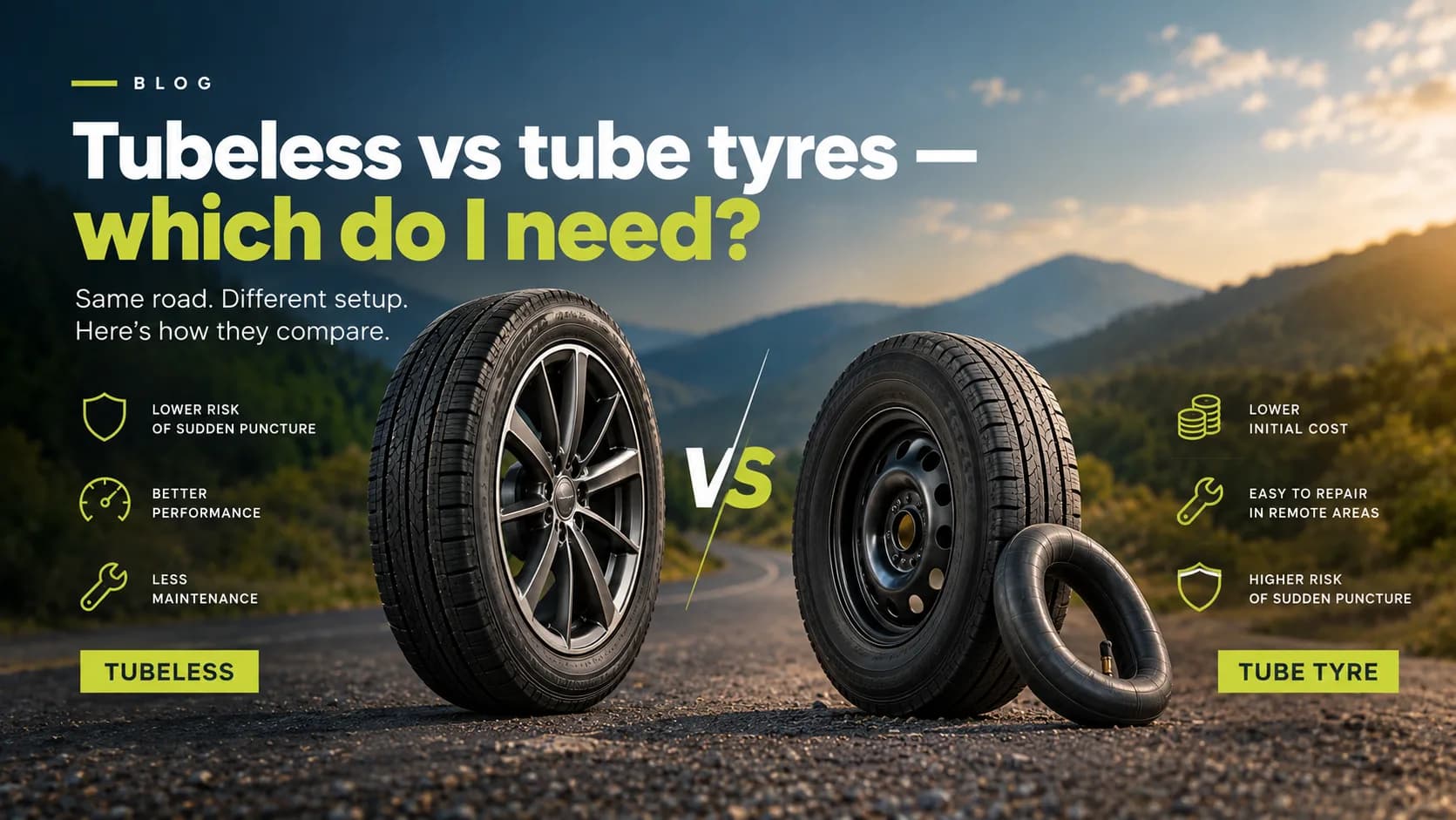
Fit tubeless if your wheel is designed for it, which almost every car and most modern motorcycle wheels are. A tubeless tyre seals against the rim itself, so a puncture leaks slowly instead of deflating suddenly, it runs cooler, and small tread punctures can often be repaired without taking the wheel off. Tube-type is still correct for spoked wheels, older commercial and farm rims, and three-wheelers. The rim decides, not preference: a tube-type rim will not hold air without a tube.
The practical difference
| Tubeless | Tube type | |
|---|---|---|
| Air seal | Tyre seals against the rim | Inner tube holds the air |
| Puncture behaviour | Leaks slowly — usually drivable to a shop | Can deflate suddenly |
| Repair | Often repairable in place, wheel on | Wheel and tyre off, tube patched or replaced |
| Running temperature | Cooler — no tube friction | Warmer |
| Weight | Lighter | Heavier |
| Rim needed | Tubeless-rated rim, in good condition | Any compatible rim |
The safety argument, which is the real one
The reason tubeless became standard is not convenience. When a tube-type tyre is punctured, the tube can tear and dump its air in a second or two, and a sudden deflation at speed is genuinely dangerous. A tubeless tyre punctured by the same nail typically loses pressure over minutes, which usually gives you enough warning to slow down and pull over safely.
When tube type is still the right answer
- Spoked motorcycle wheels — the spoke nipples pass through the rim and it cannot seal.
- Older commercial and truck rims that were never designed as tubeless.
- Most farm and tractor tyres.
- Three-wheelers.
- A tubeless rim that is corroded, buckled or has a damaged bead seat — it will not hold a seal until it is repaired.
Can I fit a tubeless tyre to my existing rim? Only if the rim is tubeless-rated and the bead seat is in good condition. Bring the wheel to any SPC branch in Ahmedabad and we will check the rim rather than guess — a tubeless tyre on an unsuitable or damaged rim will leak, and a slow leak with no puncture in the tread is almost always the rim, not the tyre.
Two things people get wrong about tubeless
- Putting a tube inside a tubeless tyre. It is done as a roadside bodge and it should not stay. The tube chafes against the tyre’s inner liner, runs hot, and the assembly is no longer rated for the load it was designed for.
- Trusting an aerosol sealant as a repair. Sealant gets you home. It does not seal the puncture channel through the casing, and it makes a proper patch-plug repair messier to do afterwards. Have the tyre repaired properly within a day or two.
Common questions
Is tubeless better than tube type?
For any wheel designed for it, yes. A tubeless tyre loses air slowly rather than suddenly when punctured, runs cooler, weighs less, and small tread punctures can often be repaired without removing the wheel. Tube type remains correct for spoked wheels, most farm and tractor tyres, three-wheelers and older commercial rims.
Can I put a tube in a tubeless tyre?
It is done as a temporary roadside fix but it should not be left in place. The tube chafes against the tyre’s inner liner and runs hotter than the tyre was designed to run, and the assembly no longer carries the load rating it was built for. Have the tyre repaired or replaced properly instead.
Why is my tubeless tyre losing air with no puncture?
Usually the rim rather than the tyre. A corroded, buckled or kerbed bead seat will not hold a seal, and a bent rim from a pothole is the most common cause in Ahmedabad. A perished valve is the other candidate. Shah Patel & Co. can straighten a bent rim and re-seat the bead, which is far cheaper than replacing an alloy wheel.